Wrist Contusion
Normal Wrist Anatomy and biomechanics
The wrist is a biomechanically complex joint allowing the wrist to move in extension (up), flexion (down), radial deviation (towards the thumb), ulnar deviation (towards the small finger) and minimal degrees of rotation. Functionally the wrist’s primary role, like the shoulder and elbow, is to position the hand in space. This accurate positioning, allows the hand to perform a vast array of activities that range from skillful manipulation of fine objectsto handling heavy objects, including supporting the entire body weight.
To understand the wrist we arbitrarily divide it into 3 layers:
-
1- First layer corresponds to the bones
2- Second layer corresponds to the capsule and ligaments
3- Third layer corresponds to the remaining soft tissues (tendons, muscles, nerves, vessels)
These three layers are covered by the skin which we will discuss below.
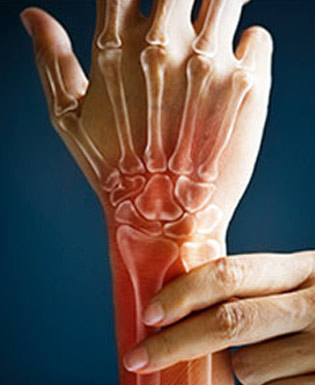
The first layeror bonylayer begins at the metacarpal bases distally (finger side), and extends towards the very end of the forearmbones proximally (elbow side). The bones comprising the wrist include the 5 metacarpal bases, 8 carpal bones (wrist bones) which are organized in 2 rows and the distal ends of the radius and ulna (forearm bones). From distal (finger side) to proximal (elbow side), these bones form the following joints:
The five carpo-metacarpal(CMC) joints, midcarpal joint, radiocarpal joint, ulnocarpal jointand thedistal radio-ulnar joint (DRUJ).

The First CMC joint is at the base of the thumb and articulates with the trapezium, a carpal wrist bone, shaped like a horse’s saddle, that permitsa wide range of motion including thumb rotation of 120 degrees, distinguishing humans from other mammals. The First Metacarpal and Trapezium are supported by a strong set of ligaments that surroundthe joint (second layer) allowing stable,thumb opposition against the rest of the fingers. The ability to oppose the thumb is responsible for 40 % of the function generated bythe hand. The CMC joints of the 2nd and 3rd digits have minimal motion secondary to short, taut ligaments that surround the joint at the 2nd (index) and 3rd (middle) metacarpals bases and the distal end of the carpal bones including the Trapezium,Trapezoid and Hamate bones. This unit serves as the stable foundation around which the thumb, ring and small fingermetacarpals move around. The CMC joints of thering and small fingers are formed by 4th and 5th metacarpals, capitate and hamate wrist bones. These joints are more mobile and together with the 1st metacarpal create a gutter or cup configuration in the palm of the hand that facilitates the gripping of instruments and small objects.
The carpal bones comprise 8 wrist bones that function as a unit by virtue of having limited motion between each other. Only 7 of the 8 carpal(wrist) bones play a significant functional role in wrist stability and mobility. The 7 important bones are named starting at the distal row (finger side) and from the thumb side: 1- Trapezium, 2- Trapezoid, 3- Capitate, 4 Hamate, and in the proximal row starting on the thumb side the 5- Scaphoid, 6- Lunate and 7- Triquetrum. The Pisiform is the eighth bone but does not play a functional role, however, itcan be a source of wrist pain when sustaining a fracture or as a consequence of degenerative arthritis in the pisotriquetral articulation.The carpal bones are almost entirely covered by cartilage and receive their limited blood supply through small vessel branches that enter the bones through little tunnels where the ligaments attach.
Just proximal to the carpal bones (elbow side) are theRadius and Ulna whose articular surfaces form a cup that complements the carpal bones. Together, they form the radiocarpal joint that serves to support the proximal carpal row in a functional ball and socket mechanism. The radius with a much larger articular surface to cradle the carpus, transfers about 80 % of the wrist load. The radius and ulna have a second joint that provides forearm rotation called the Distal Radio Ulnar Joint (DRUJ). The Triangular FibroCartilage Complex is a fibrous structure containing collagenous fibers (ligaments) embedded in a fibrocartilage matrix that complements the distal end of the radius and ulna to complete the cup configuration. The DRUJ provides a cushion between the carpus and the distal ulna and is considered the main stabilizer of the DRUJ. For full normal forearm rotation to occur, the DRUJ is complemented at the elbow by a joint called the proximal radio-ulnar joint (PRUJ).


The Second Layeris composed of the wrist ligaments, a complex intermingling of collagen fibers that join the metacarpals to the carpals and to the radius and ulna,creating stable, balanced wrist motionduring our daily activities. These ligaments are taut structures embedded in a thin capsule that function to reinforce key areas of the wrist. Between the carpal bones, a deeper layer of ligaments, called the intra-carpal ligaments,allow a restricted amount of motion and is the reason that the carpal bones function as a unit. The shape and position of the carpal bones is critical for proper function and when injury occurs, it is of vital importance to re-establish the bone anatomic shapes if normal function is to be achieved.
The Third Layer is formed by the tendons, muscles, vessels and nerves.
The tendons about the wrist are divided into flexors (palmar side) and extensors (back hand side). The extensor tendons are in the back of the wrist and travel through 6 independent compartments having 9 of these tendons corresponding to finger motion and 3 tendons corresponding to wrist motion. Compartments 1 and 3 controls the thumb tendons, compartments 2 and 6 the wrist extensors and compartments 4 and 5 the finger extensors.


There are nine flexor tendons that travel through a fibro-osseous tunnel at the wrist called the carpal canal. It is formed by the carpal bones and the transverse carpal ligament. There are three tendons that flex the wrist but only one of these three, the flexor carpi radialis, travels in an independent wrist compartment in the carpal canal.

Radial Artery Ulnar Artery
The primary vessels or channels that supply blood to the hand while traveling across the wrist are the Radial and Ulnar Arteries. An arcade of smaller branches that interconnect the radial and ulnar arteriesare safety pathways that allow the continuation of blood flow if the radial and ulnar artery becomes occluded. The blood returns to the heart through the veins which are more prominent in the back of the hand and wrist. The major nerves about the wrist are the Median nerve that travels together with the 9 flexor tendons in the carpal tunnel, the Ulnar nerve that together with the ulnar artery travel through Guyon’s canal and the Radial nerve in the back of the forearm. Terminal smaller branches provide sensation to the superficial and deeper levels within the wrist.
Pathology
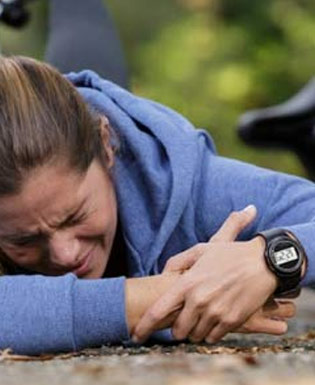
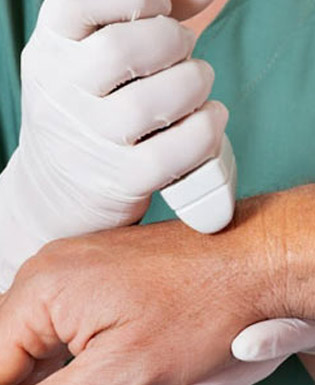
Trauma is the term used to describe injury. Trauma is classified by its severity depending on the amount of force used to cause the injury. Trauma is also distinguished according to whether it is caused by a single major force or minor repetitive, smaller forces which are cumulative (additive) over time. This is referred to as Cumulative Trauma Disorder (CTD). An injury is also classified depending on if the skin was breached, called an open injury or the skin layer stays intact, referred to as a closed injury. When an injury is minor, it is called a contusion and in this instance, it implies that the injury was closed and only involves the soft tissues including the skin, subcutaneous tissue, muscles, tendons, ligaments, arteries and nerves, alone or in combination. In a contusion, the soft tissue is bruised or stretched, but not torn and requires only symptomatic treatment. The same force of trauma sustained by different patients will result in different injury severity because changes that occur in our body’s internal structure with aging. Specific changes occurring with aging is the amount and type of collagen in our body through metabolism is converted from Type I collagen which is the typical collagen most often found in the human body is converted into Type II collagen. Type II collagen is less resilient and is the type of collagen found in healing scar. The protein, elastin, which gives tissue its stretch properties, also decreases in content with aging. Finally, the water content in the cells of the body decrease with aging. Below is a graph that depicts an identical force sustained by individuals at different ages divided into 20-year increments and the time it takes for each group to heal and become symptom-free. The white section is when the patient is symptom-free and the yellow section is when the patient is having symptoms including pain, stiffness, weakness, and poor function. Note the curve does not come back to baseline and shifts to the right with aging.

Treatment
The most common symptomatic treatment used for all types of soft tissue injuries has three approaches:
-
1. R.I.C.E. treatment,
2. Anti-inflammatory treatment
3. Controlled early motion and therapy.
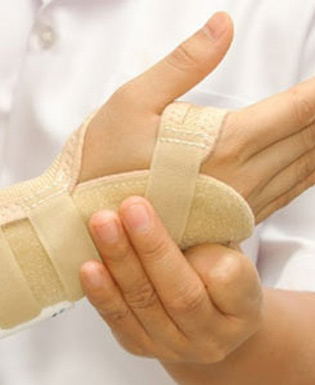
The acronym RICE stands for Rest, ice, compression and elevation. A Strain is a muscle injury and Sprain is a ligament stretch injury and both conditions are treated this way. Rest is usually done for 24-48 hours, and can include the use of slings, splints or other types of immobilizers unless otherwise advised by a physician. Ice is used for no more than 20-30 minutes at a time, three to four times per day. Ice is best applied by using a ice slush which transmits the effects of the cold sensation best and can be made by crushing ice and mixing it with water and then placing it in a zip lock plastic bag. The ice bag should not be placed in direct contact with the skin but instead should have a layer between the skin and ice bag like a towel to prevent the skin from freezing. The ice should be applied for no more than 20-30 minutes to avoid skin freezing as can occur if you fall asleep with an ice pack on your limb. Ice functions by causing the arteries to narrow the size of their lumen which in turn decreases swelling and the pain from swelling.
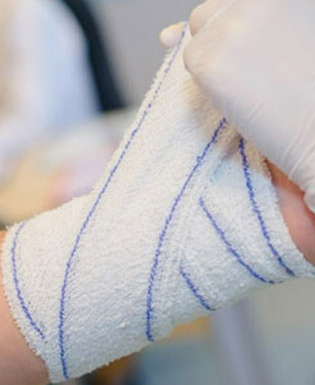
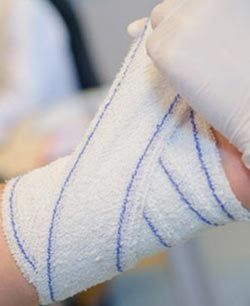
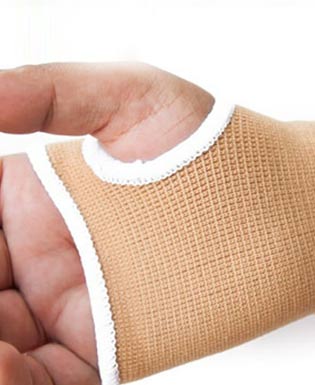
Compression is the wrapping of a body part to further assist in minimizing swelling and is used in conjunction with elevation. The best way to do a compressive wrapping is by having the compression have multiple layers that provide a cushion effect. The compression dressing is best applied by a physician and should be wrapped without causing the constriction of the blood supply which is recognized by increasing pain to the body part wrapped. Other signs of a tight compressive dressing are the cold sensation of the wrapped limb, blue discoloration of the body part, or change in color from the natural skin color. Elevation of an injured body part is best done by elevating the limb to the level of the heart. If elevation is lower than this, the effects of gravity on the veins, will increase venous pressure and cause the blood in these veins to have difficulty traveling back to the heart resulting in limb swelling.
The use of anti-inflammatory medication helps treat the pain, swelling, and inflammation that occurs after injury is imparted on a limb. Examples of anti-inflammatories include aspirin products, Ibuprofen (Motrin, Advil,) Naprosyn, Mobic, Indocin, Arthrotec,and Celebrex to name a few. All of these medications have side effects and should be taken with this knowledge in mind. Prescriptions should be discussed with your pharmacist and physician.
Controlled early motion and therapy to the involved limb decreases the effects of prolonged immobilization which includes stiffness, muscle atrophy, weakness and expedites the return to the pre-injury state. The type of therapy recommended will depend on the tissue type injured and the severity of this injury. Consult your surgeon for the best advice.
When treating a wrist contusion, the use of ice, elevation of the hand above heart level and a compressive dressing may be needed. A sling can provide comfort but is not ideal for wrist injuries because it frequently places the hand below the level of the heart when in the seating or standing position. This can worsen swelling, inflammation and the resultant throbbing pain. Therefore, it is preferable not to use a sling but instead to actively elevate the hand above heart level, like when doing the pledge of allegiance, with modifications of this position depending on body position. Carrying a pillow with you to assist in positioning of the hand may assist with this task. Mobilization of shoulder and elbow should be included in the program to prevent stiffness of these joints during the recovery period. Anti-inflammatory medication is helpful during the first 2-4 weeks after injury depending on the injury severity. The home exercise program given to the wrist is referred to as the six pack hand program and is provided below. The program is progressed from exercise one through six. This is important because with wrist injuries, inflammation typically extends to the hand, that if immobilized can pre-existing conditions like arthritis of the hand resulting in significant stiffness and loss or motion. The wrist should be mobilized early with the assistance of the contralateral uninjured hand. Placing the wrist in the praying position and in the opposite direction is helpful in preventing stiffness. Exercises like throwing a dart facilitate a gentle –ergonomic exercise for the wrist.